Please wait while we open this resource.


K

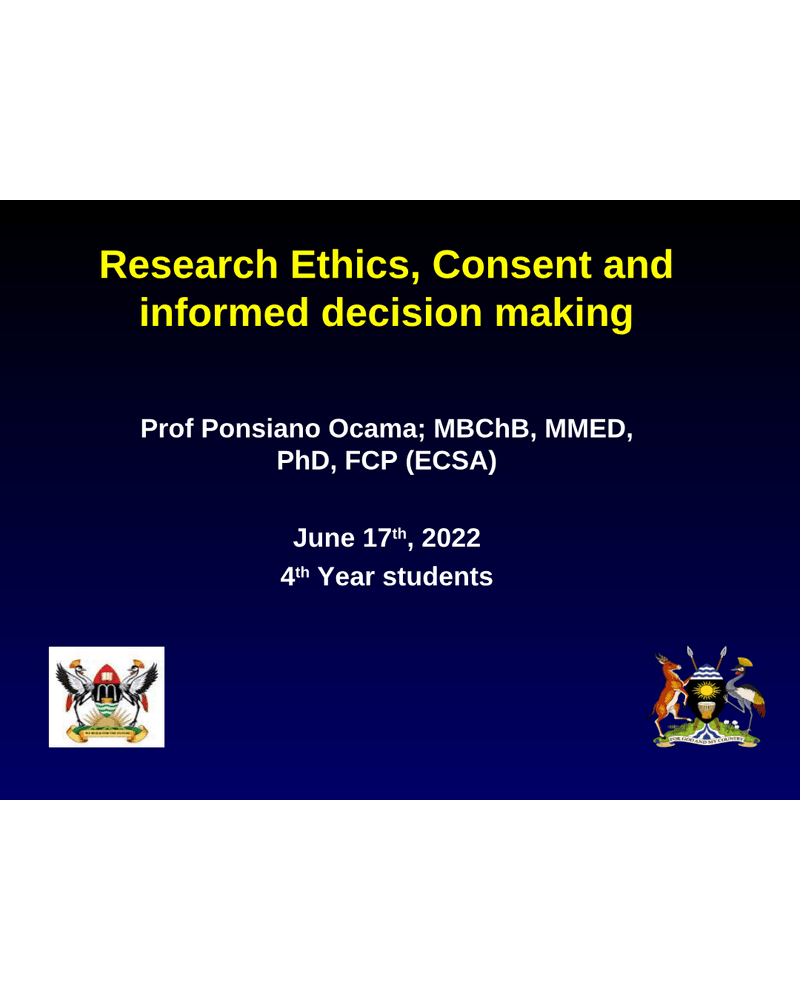
Lecture slides
Reserach Ethics, Consnet And And Informed Decision Making
Prof Ponsiano Ocama
PPTX202222 pages170 KB
The document outlines core ethical principles such as autonomy, beneficence, non‑maleficence, and justice, and explains their application in research settings. It reviews landmark events like the Nuremberg Code, the Tuskegee Syphilis Study, the Helsinki Declaration, and the Belmont Report that shaped modern research ethics. The role, composition, and responsibilities of Research Ethics Committees (RECs) and Institutional Review Boards (IRBs) are described, emphasizing protection of participants and ongoing monitoring. Detailed components of informed consent—including information, understanding, and choice—are provided alongside practical elements for consent forms. The material is intended for fourth‑year medical students to support informed decision‑making and ethical conduct in research.
Sign in to open
Ask this resource
Answers use this document only.
Your first question is free.
More like this
Resources from the same specialty and type. Curated links will replace these when added.
Clinical Resources
Documents that extend or complement this resource.

Human Rights
Same clinical topic · Medical Ethics & Professionalism
Principles of Bioethics
Same clinical topic · Medical Ethics & Professionalism
PRINCIPLES OF MEDICAL ETHICS
Same clinical topic · Medical Ethics & Professionalism

Medical Records Management Principles
Same clinical topic · Medical Ethics & Professionalism
Confidentiality Of Medical Information
Same specialty · Medical Ethics & Professionalism

Consent And Informed Decision Making
Same specialty · Medical Ethics & Professionalism
Medical ethics
Same specialty · Medical Ethics & Professionalism
The Hippocratic Oath and declaration councils
Same specialty · Medical Ethics & Professionalism

The medico-legal aspects of death
Same specialty · Medical Ethics & Professionalism