Preparing your experience, please wait…


K

Clinical reviews
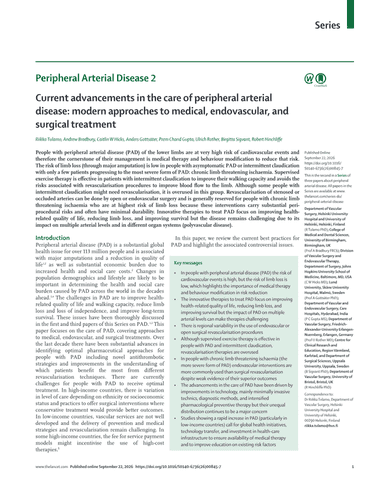
CURRENT ADVANCEMENTS IN THE CARE OF PERIPHERAL ARTERIAL DISEASE
Helsinki University
PDF202612 pages550 KB
Peripheral arterial disease (PAD) poses a significant global health challenge, particularly affecting the lower limbs and increasing the risk of cardiovascular events. The management of PAD focuses on medical therapy, lifestyle changes, and, when necessary, surgical interventions. Innovative therapies aim to enhance health-related quality of life, reduce limb loss, and improve survival rates. The document provides insights into treatment strategies, including supervised exercise therapy and the role of revascularization procedures, while addressing the complexities of managing patients with polyvascular disease.
No account needed
Ask this resource
Answers from this document onlyMore like this
Resources from the same specialty and type. Curated links will replace these when added.
Clinical Resources
Documents that extend or complement this resource.
OPTIMAL DIURETIC STRATEGIES IN HEART FAILURE
Same clinical topic · Cardiology
ARRHYTHMIC SYNCOPE: FROM DIAGNOSIS TO MANAGEMENT
Same clinical topic · Cardiology
DIRECT ORAL ANTICOAGULANTS IN PRIMARY AND SECONDARY PREVENTION OF THROMBOTIC EVENTS: 2026 ACC SCIENTIFIC STATEMENT
Same clinical topic · Cardiology
PULSED FIELD ABLATION VS STANDARD RADIOFREQUENCY ABLATION FOR TYPICAL ATRIAL FLUTTER
Same clinical topic · Cardiology
BEYOND THE 4 PILLARS
Same clinical topic · Cardiology
SURVIVAL AFTER INITIAL STRESS TESTING VS ANATOMIC TESTING IN SUSPECTED CORONARY ARTERY DISEASE
Same clinical topic · Cardiology
MOBITZ TYPE II SECOND-DEGREE ATRIOVENTRICULAR BLOCK: A COMMONLY OVERDIAGNOSED AND MISINTERPRETED ARRHYTHMIA
Same clinical topic · Cardiology
GLOBAL BURDEN OF VENOUS THROMBOEMBOLISM: INCIDENCE AND OUTCOME ESTIMATES OF DEEP-VEIN THROMBOSIS AND PULMONARY EMBOLISM
Same clinical topic · Cardiology
DIURETIC TREATMENT IN HEART FAILURE
Same clinical topic · Cardiology