Please wait while we open this resource.


K

Clinical notes
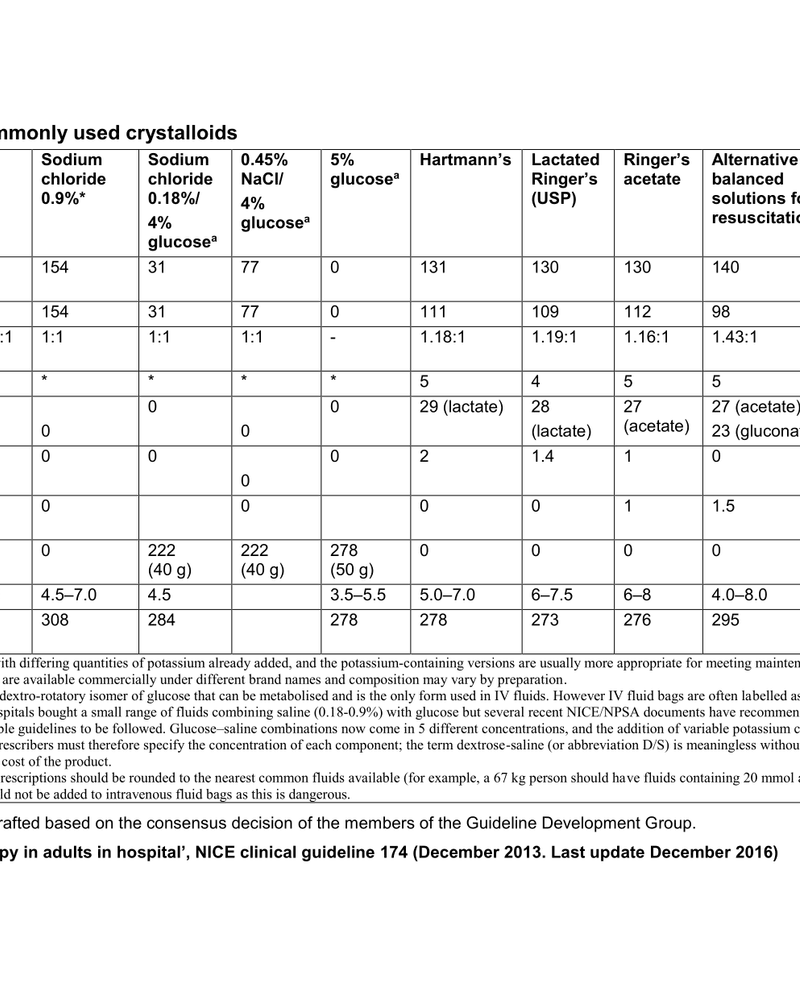
COMPOSITION OF COMMONLY USED CRYSTALLOIDS
Critical Care
PDF20161 pages230 KB
The table includes information on the electrolyte content, pH, and osmolarity of different crystalloid solutions such as Sodium Chloride, Hartmann’s, and Lactated Ringer’s. It highlights the importance of specifying concentrations of components in intravenous fluids to adhere to clinical guidelines and ensure patient safety. The data is based on consensus from a guideline development group and references established clinical guidelines.
Sign in to open
Ask this resource
Answers use this document only.
Your first question is free.
More like this
Resources from the same specialty and type. Curated links will replace these when added.
Clinical Resources
Documents that extend or complement this resource.
Handbook of Critical and Intensive Care Medicine
Same clinical topic · Critical Care

The Vasopressor Inotrope Handbook Eddy J (1). Gutierrez
Same clinical topic · Critical Care
Kiruddu National Referral Hospital Treatment Algorithms
Same specialty · Critical Care
LEFT VENTRICULAR-ARTERIAL COUPLING IN SEPTIC SHOCK: A PHYSIOLOGICAL REVIEW
Same specialty · Critical Care

INTERNATIONAL MULTIDISCIPLINARY CONSENSUS STATEMENT ON SEPSIS CODE GUIDELINES: A DELPHI APPROACH
Same specialty · Critical Care
CENTRAL VENOUS PRESSURE REVISITED: PHYSIOLOGY, PITFALLS, MISCONCEPTIONS, AND MODERN CLINICAL INTERPRETATION IN CRITICAL CARE
Same specialty · Critical Care

SEPTIC SHOCK2345-1 (2)
Same specialty · Critical Care
HOW I PERSONALIZE FLUID THERAPY IN SEPTIC SHOCK?
Same specialty · Critical Care
PRINCIPLES OF FLUID MANAGEMENT
Same specialty · Critical Care